

Antwerpreneurs is the newsletter of Antwerp’s business stories.
We talk to founders, share their journeys, and the lessons they learned along the way.
Missed the last issue? No worries, you can catch up here!
Today
✋ Antwerpreneur: Denis Leysen - Founder of noah and CEO
🧃 Giggle Juice: By Irregular Galaxy Doods
💎 Quiz Question: Between 2010 and 2023, about how many AI start-ups were identified in Belgium?
✋ Antwerpreneur: Denis Leysen
A conversation with Denis Leysen, founder and CEO of noah, about building an AI startup that does in 60 minutes what used to take months, and why nothing is real until someone pays.

Denis tries to shut everything down around 10pm.
No phone. No social media. No scrolling into the night.
Sometimes he reads. Sometimes it's just a TV show.
Because building a startup, he says, feels like an extreme sport.
In the way where you're constantly out of breath, out of your comfort zone, and quietly asking yourself the same question again and again:
Can I actually do this?
"You can read all the books you want," Denis says. "But you won't know what it feels like until you're really in it."
And once you are, there's no turning it off.
What noah actually does (without the buzzwords)
At first glance, noah sounds like another AI company.
But Denis is very clear about what they do.
In simple terms: an AI that interviews your employees, detects high-impact AI use cases, and instantly matches them with the right tools and partners. All in one platform.
Here's how it works:

An AI interviewer talks to employees about their job, their role, what works, what doesn't. A 10-15 minute smart voice conversation that uncovers pain points, inefficiencies, and opportunities for automation. Five people. Twenty. A hundred. At the same time.

Noah automatically connects internal pain points with the latest AI capabilities and real-world use cases from across the market with a database of 10,000+ examples from different industries and countries.

You get a shortlist of relevant, high-ROI AI use cases, matched to your company's systems, teams, and goals.

Each use case comes with practical next steps, suggested tools, and pre-matched experts who can implement them.
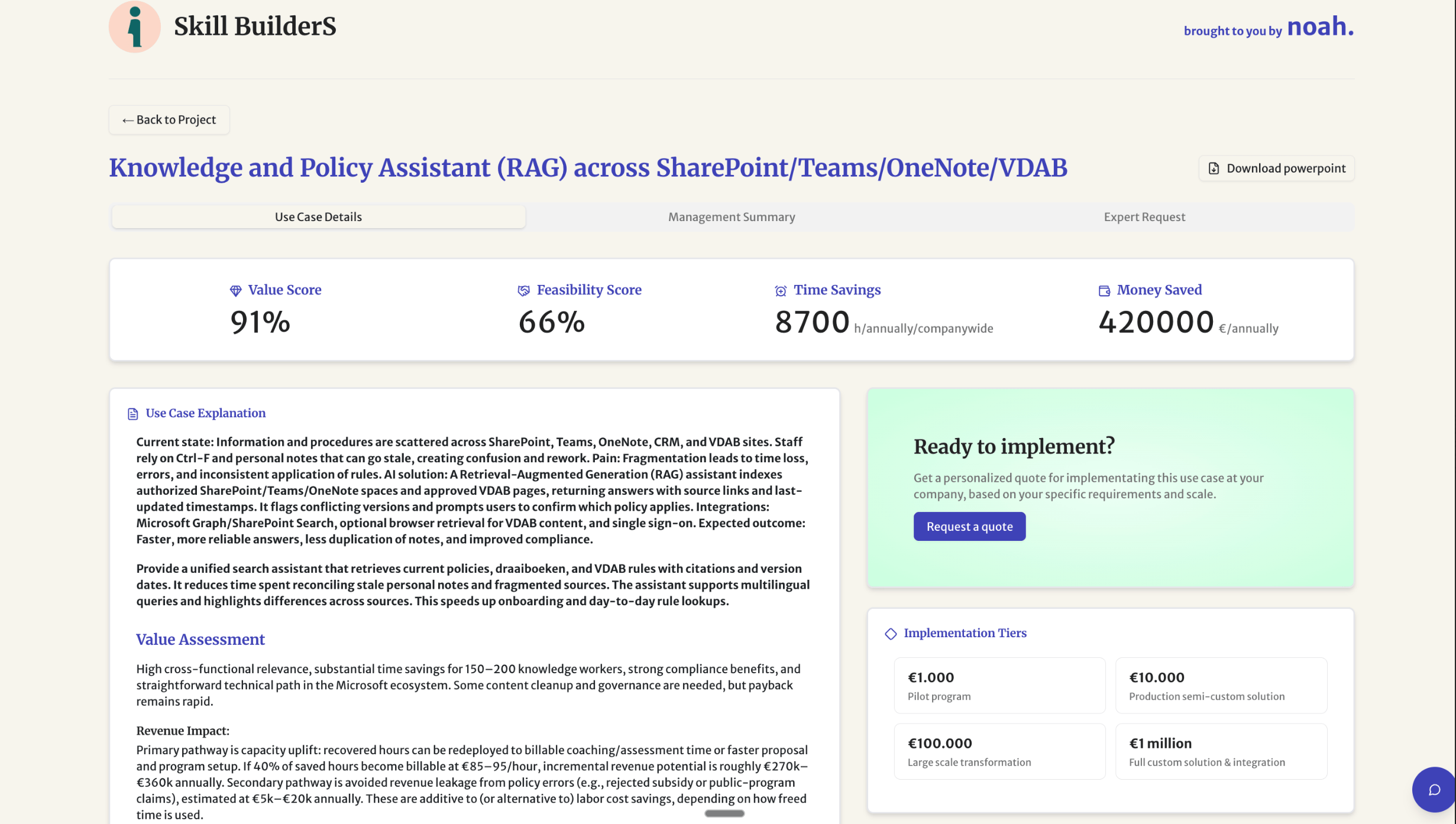


The result?
A prioritized list of concrete business cases: how much time and money can be saved, how feasible it is, why it matters, and how other companies have already done it.
Not ideas. Not theory.
Decisions.
"You can run a pilot in 30 minutes and already see first priorities," Denis says.
Noah is ideal for transformation and innovation managers, or anyone whose job is to constantly change things.
Especially when the pressure is on.
When urgency meets reality
Denis gives a recent example.
A management team member needed to present cost-saving initiatives to the board. Target: reduce costs by 5%. Deadline: end of the week.
He had two options.
Option one: start from his own assumptions, talk to a few people, build a business case based on experience and intuition.
Option two: use noah. Let the organization speak for itself. Let the data surface what's actually happening.
"The guy, in my opinion, has two choices," Denis explains. "Either start from his own assumptions, talk to some people, build up a business case. Or he says, no, I can use noah to do it for me. Guess what he picked."

Giphy
Where the idea really came from
Before noah, Denis worked at Datashift for four years.
He spent his time helping companies understand and use data. And over time, one frustration kept coming back.
The discovery phase took forever.
Endless conversations. Repetitive questions. Long processes just to understand what was already happening inside a company.
"We went to companies and started asking a lot of questions to gather data and it took a lot of time. I thought this was not really efficient, especially that discovery process."

Giphy
His first startup idea wasn't noah.
It was about LLM governance: tracking sensitive data input, controlling what employees put into AI systems.
It made sense in theory. In reality, he couldn't sell it.
Microsoft was already moving there. Some companies just blocked tools or websites entirely.
"After a couple of months, I switched the idea to noah."
The pivots nobody talks about
Denis has pivoted his startup idea several times.
LLM governance. Then LLM monitoring. Then explainability. Then observability. Then GenAI analytics.
Most founders would see this as failure.
Denis sees it differently.
Each pivot taught him something. Each one got closer to what companies actually needed.
The lonely part of being a non-technical founder
If you're a non-technical founder, you can't do this alone.
"You're dependent on freelancers and externals, which you really don't want because you go much slower, it's expensive and they don't fully understand your vision. So you need a partner that understands all of that."
That dependency hurts.
Today, noah is built by three people.
Denis handles sales and the commercial side. Tom De Smedt (CTO) and César Van Leuffelen (UX/UI) joined as shareholders in the summer.
Getting there wasn't easy.
Two previous co-founders didn't work out.
"What it taught me is that very quickly you have to get to the essence of what triggers people, what motivates people, what is their vision, what do they want."
With Tom and César, that alignment was there from the first conversation.
César, he met through the Y Combinator matchmaking platform.
"I was on that platform for a year already. Then just before summer, I looked at it and saw someone from Belgium. You don't often see people from Belgium, so I just sent a message and that's how it started."
Tom initially approached Denis as a client but wanted to know more.
"And then one thing led to another."

The moment when things become real
You can have the best ideas in the world.
None of them matter until someone pays.
"Only at the point where a client says yes, I want to pay and yes, I want to continue, you're onto something."
And early on, a mistake he made is that he priced the product too low.

Giphy
That lesson came fast.
"When you sell something for thousands of euros, prospects are more serious. They look at you with much more credibility and have a different mindset."
Today, noah works with yearly subscriptions, typically in the five-figure range and up.
Because transformation isn't a one-off event. AI changes fast. Six months later, entirely new tools exist.
Companies can rerun the model and discover new opportunities that didn't even exist before.
Why timing beats convincing
One thing Denis learned: you can't force urgency.
Prospects need to feel the pain.
So instead of pushing, noah stays close. They share value.
Concrete examples. Competitor use cases. Real numbers, not promises.
"When we do discovery calls, we always start off the conversation with questions and then show examples from the markets using data from our database.
Only then does the business case start to make sense.

Giphy
The real vision
"Our dream, our hope, our vision is that companies can spot problems much faster and find solutions. Especially the hidden problems, the ones that you don't see."
To surface hidden problems inside organizations. The ones leaders don't see. The ones no dashboard shows.
And once those problems are visible?
To immediately match companies with the right solutions. The right providers. The right builders. In the right budget range. In the right way of working.
No endless searching. No boring vendor calls.
"If you have a product that I believe is as powerful as we have, being able to work in any language, in any country is the goal."
The New Year's Eve declaration
Three years ago, Denis wouldn't have called himself a future founder.
On New Year's Eve, he said something out loud:
"Next year I want to be doing something completely different."
He told friends. Family. His girlfriend.
"I said it out loud to friends, family, and my girlfriend, because then it became a bit real."
It forced conversations. With his manager and with people outside his usual bubble.
"You're dependent on yourself for your own success so you cannot blame anyone else. And I like to have that control. It's just you against yourself."
What surprised him most was the entrepreneurial community in Belgium.
"I didn't expect to like it that much. It's amazing, fun, and really helpful."
Sell before you build
Denis is very direct about this.
Try to sell your idea before it fully exists. Especially now.
"With no code or vibe code, you can build a product and demo it to prospects. Try to sell the idea of your product before you fully build it."
That's exactly what he did.
"I sold a no code product which didn't fully work."
Not to fake it. But to find out if there was demand and market fit.
“You don't know if you'll make it. You doubt yourself constantly. You only learn by doing.”
Denis didn't plan to become a founder.
But once he stepped in, he discovered something important:
Nothing is real until someone pays.

Denis’ Recommendations
People: Follow yourself
Podcast: Tech Wolf
Favorite Activity: Playing football
Song playing on repeat: Incredible sauce from Giggs
Favorite place in Antwerp: Berchem Sport's stadium
Antwerpreneur-to-Antwerpreneur Q&A
Question: What’s the biggest mistake that you don't regret looking backwards because you learned a very valuable lesson?
Denis’ answer: “I wouldn’t say I made a mistake, but I had no clue what starting a company meant before I quit my job. I was maybe a bit naive but I'm so happy I did it”
Where can you find Denis?
You can find him on LinkedIn.
💬Enjoyed this story? Go like or comment our post on our Linkedin page—every little thing helps us get these stories out there!
🧃 Giggle Juice
🐒 ✊

Every story here is researched, interviewed, and written by me. If you like this kind of work, supporting it helps keep it going.


Giphy
💎 Quiz Question
Between 2010 and 2023, about how many AI start-ups were identified in Belgium according to a study by the Federal Planning Bureau and Ghent University?
A) About 74
B) About 240
C) About 744
D) About 7,400
You can find the answer at the end
Pura Vida! 🦥
Jose
P.S. Got 3 seconds? We’re not mind readers (yet), so we need your help to rate this issue!

If you enjoyed the newsletter, please share it with your friends and family!
Forwarded this email? Sign up here
Answer: C) About 744
